We launched the GitHub Innovation Graph to give developers, researchers, and policymakers an easy way to explore and analyze global trends in open source software development. It offers a reliable, transparent dataset that tracks public collaboration activity across regions over time.
Our latest quarterly update now includes data through March 2025, which means the Innovation Graph spans more than five years of insights into the global software economy.
Data visualization and AI continue to gain momentum, and more broadly, the Innovation Graph is becoming an increasingly valuable resource for anyone looking to ground their work in trusted, real-world developer data.
Let’s jump in.
We’ve added bar chart race videos to the git pushes, repositories, developers, and organizations global metrics pages.
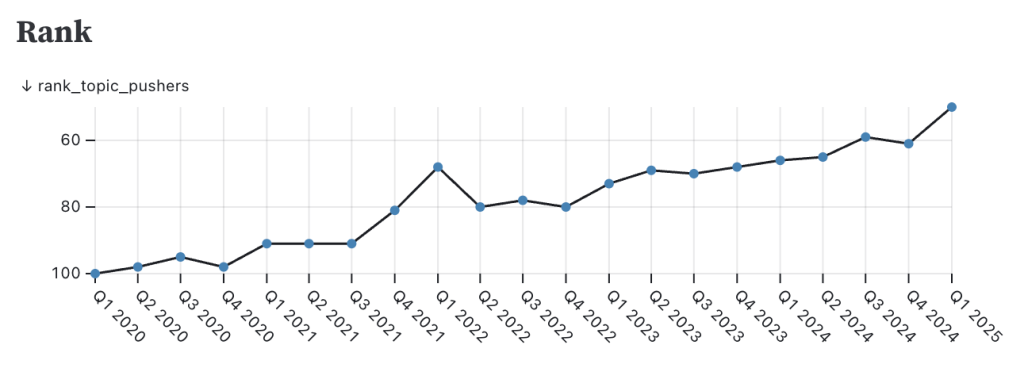
In Q1 2025, data-visualization finally appeared as one of the top 50 topics by the number of unique pushers:

Starting from way down in rank 100 in Q1 2020, it’s been an arduous journey:
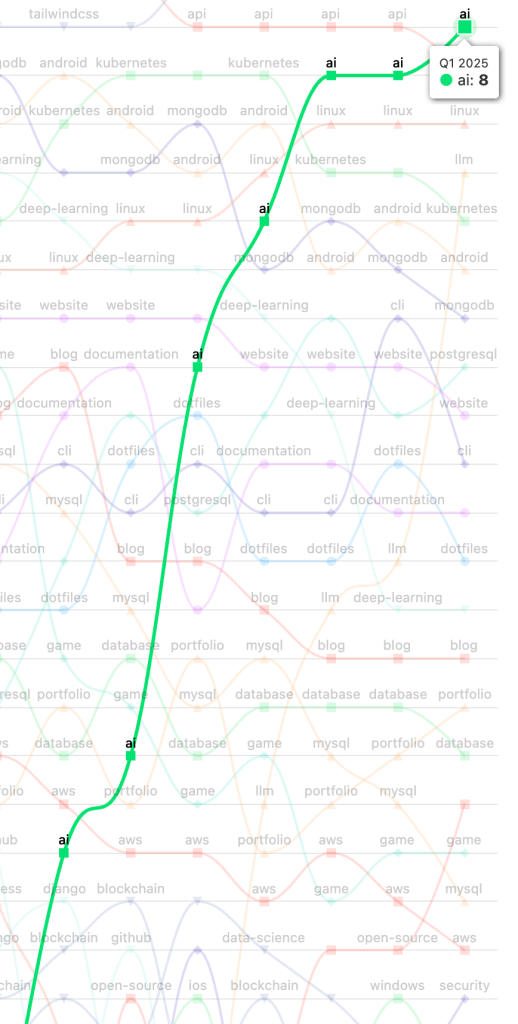
Not every repository topic has the kind of trajectory as ai:
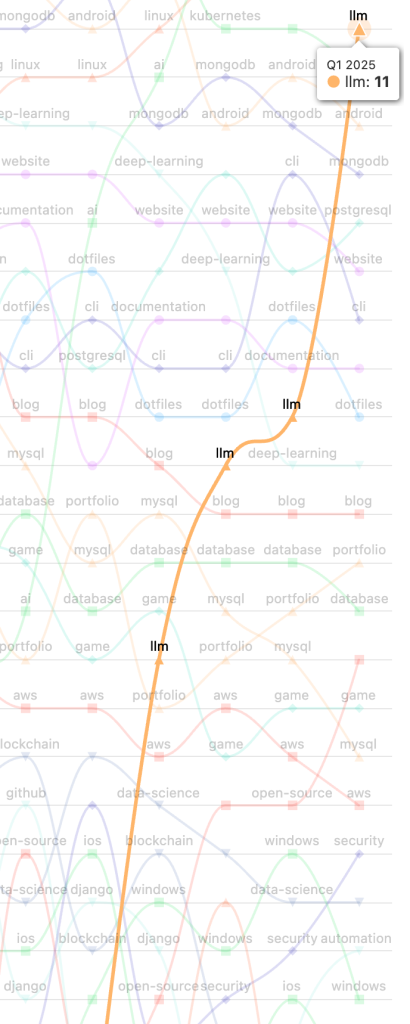
Or llm:
Finally, we’d like to highlight some of the recent research reports and papers that caught our interest — and that utilize GitHub and Innovation Graph data:
Published by the Stanford Institute for Human-Centered AI (HAI), the AI Index Report tracks and monitors trends in AI development and diffusion, synthesizing insights relevant to businesses, policymakers, researchers, and the general public. Check out Section 1.6 of the report for their analysis of public AI-related software projects on GitHub over time, showing a sharp increase in 2024.
- Nestor Maslej, Loredana Fattorini, Raymond Perrault, Yolanda Gil, Vanessa Parli, Njenga Kariuki, Emily Capstick, Anka Reuel, Erik Brynjolfsson, John Etchemendy, Katrina Ligett, Terah Lyons, James Manyika, Juan Carlos Niebles, Yoav Shoham, Russell Wald, Tobi Walsh, Armin Hamrah, Lapo Santarlasci, Julia Betts Lotufo, Alexandra Rome, Andrew Shi, Sukrut Oak. “The AI Index 2025 Annual Report,” AI Index Steering Committee, Institute for Human-Centered AI, Stanford University, Stanford, CA, April 2025.
Researchers found that participating in a corporate accelerator program increased startups’ future funding by more than 40%. Innovation Graph data was used as a measure of regional technical labor capacity.
Researchers analyzed StackOverflow to develop a large-scale, fine-grained taxonomy of software development tasks. They found that in particular, Python developers are more likely to pursue tasks associated with higher wages, possibly because Python’s versatility enables them to more readily pick up skills in disparate and unfamiliar areas. Innovation Graph data provided a way to assess the representativeness of the distribution of programming languages used by StackOverflow users.
- Feng, X., Wachs, J., Daniotti, S. and Neffke, F., 2025. The building blocks of software work explain coding careers and language popularity. arXiv preprint arXiv:2504.03581.
Researchers trained a classifier to detect AI-generated Python functions, finding that AI generated 30% of Python functions committed on GitHub by US developers. This resulted in a 2.4% increase in total quarterly commit volume, which generates an estimated $9.6-14.4 billion in value annually.
- Daniotti, Simone, Johannes Wachs, Xiangnan Feng, and Frank Neffke. “Who is using AI to code? Global diffusion and impact of generative AI.” arXiv preprint arXiv:2506.08945 (2025).
Researchers developed an indicators-based approach to assessing societal resilience to advanced AI across three dimensions: structural factors that might predispose a society to AI risks (“vulnerability”); capacity to prevent, absorb, and recover from AI risks (“resilience”); and capacity to leverage AI systems to mitigate AI risks and reconfigure the society toward systemic safety (“transformation”). The Innovation Graph was cited in the prototype framework as a data source to use as a proxy to measure a society’s human capital in the domain of cyber security.
- Milan M. Gandhi, Peter Cihon, Owen C. Larter, and Rebecca Anselmetti. 2025. Societal Capacity Assessment Framework: Measuring Advanced AI Implications for Vulnerability, Resilience, and Transformation. In ICML Workshop on Technical AI Governance (TAIG). Retrieved from https://openreview.net/forum?id=8gn9NeL0Ai.